




Wenn Wörter töten könnten (Epub)
45.00 kr
Axel Thormählens Literatur-Thriller Wenn Wörter töten könnten ist ein mit einer gehörigen Portion Satire angereicherter, spannender Roman, dessen Handlungen sich hinter den Kulissen des Literatur-Betriebs abspielen. Die verschiedenen Intrigen dehnen sich von Hamburg bis ins schwedische Universitätsstädtchen Lund, um auf der Insel Gotland ihre Auflösung zu finden.
Erschien Anfang Mai 2020 in einer Neuauflage bei JMB Verlag.
Related products

Eine Wintertaufe
und andere weihnachtliche Erzählungen
JMB Verlag, 2010
Das Phänomen „Weihnacht“ hat schon viele Schriftsteller/innen fasziniert. Einige Weihnachtsgeschichten, z. B. Charles Dickens’ A Christmas Carol, sind mittlerweile Klassiker der Weltliteratur. Das Thema erschöpft sich nicht; immer wieder gibt es neue Aspekte von diesem Fest der Hoffnung, das mitten im Winter den Alltag vorübergehend vertreibt. Dazu gehören die bis zum Heiligabend aufgesparten Erwartungen, die manchmal erfüllt werden und manchmal nicht. Axel Thormählen wollte eigentlich nur die eine echte Weihnachtsgeschichte schreiben und dabei das Geheimnis lüften, was Menschen mit diesem Fest verbindet. Es hat sich aber erwiesen, dass das mit einer einzigen Geschichte nicht möglich ist. Allerdings unterscheiden sich die hier vorliegenden fünf Erzählungen wohl in ihrem Ausgangspunkt, doch nicht in der Aussage, nämlich dass Wunder passieren, auch wenn sie als solche nicht wahrgenommen werden. Zuweilen geschehen sie eben gerade zur Weihnachtszeit.
Bestellung für Eine Wintertaufe und andere weihnachtliche Erzählungen an Jens Bolm .

Rochester – The Poems in Context (paperback)
The 1999 Oxford University Press edition by Harold Love of the works of John Wilmot, 2nd Earl of Rochester, praises Marianne Thormählen's Rochester: The Poems in Context (Cambridge University Press, 1993; a paperback edition appeared in 2006) as the most up-to-date book on Rochester's poetry, a "fresh, personal, and profoundly learned" study (pp. xlvi-xlvii). Other scholars have called it "splendid" (The Yearbook of English Studies), "intelligent and careful" (The Review of English Studies), "judicious" (Times Literary Supplement), and "smart and useful ... a treasure trove of information [for which] readers of Rochester will be indebted to Ms Thormählen for years to come" (The Scriblerian).
Marianne Thormählen regards Rochester as a serious poet who devoted much time and care to his verse and aimed for the highest standards in his writing. This view runs counter to the traditional idea of Rochester as the "wicked earl" who wrote with ease; but she bolsters it with convincing evidence of painstaking literary desk-work, deliberate exploitation and subversion of poetical conventions, and subtly crafted references to people and events in Charles II's and Louis XIV's Europe. Rochester's much-talked-about obscenities are shown to belong within a sombre framework of dissatisfaction with sensual pursuits and distrust of male sexual ability. The book ends with a consideration of Rochester's famous deathbed conversion. A select bibliography directs the reader to every notable work on Rochester up to 1990.
Rochester: The Poems in Context, hardback
Rochester: The Poems in Context, paperback

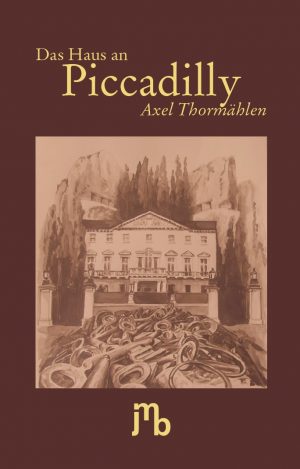
Das Haus an Piccadilly
JMB Verlag, 08 Juni 2012
Ein geheimnisvolles Haus in London erregt seit Jahren die Neugier von Leo Norman. Durch unheimliche Umstände gelangt er an das riesige Schlüsselbund dieses Hauses und stattet ihm einen unvergesslichen Besuch ab ...
Bestellung für Das Haus an Piccadilly an Jens Bolm .
"Hinter Thormählens Sprachwitz steckt ein Philosoph!"
Kunst + Kultur No. I/09
Rochester – The Poems in Context (hardback)
The 1999 Oxford University Press edition by Harold Love of the works of John Wilmot, 2nd Earl of Rochester, praises Marianne Thormählen's Rochester: The Poems in Context (Cambridge University Press, 1993; a paperback edition appeared in 2006) as the most up-to-date book on Rochester's poetry, a "fresh, personal, and profoundly learned" study (pp. xlvi-xlvii). Other scholars have called it "splendid" (The Yearbook of English Studies), "intelligent and careful" (The Review of English Studies), "judicious" (Times Literary Supplement), and "smart and useful ... a treasure trove of information [for which] readers of Rochester will be indebted to Ms Thormählen for years to come" (The Scriblerian).
Marianne Thormählen regards Rochester as a serious poet who devoted much time and care to his verse and aimed for the highest standards in his writing. This view runs counter to the traditional idea of Rochester as the "wicked earl" who wrote with ease; but she bolsters it with convincing evidence of painstaking literary desk-work, deliberate exploitation and subversion of poetical conventions, and subtly crafted references to people and events in Charles II's and Louis XIV's Europe. Rochester's much-talked-about obscenities are shown to belong within a sombre framework of dissatisfaction with sensual pursuits and distrust of male sexual ability. The book ends with a consideration of Rochester's famous deathbed conversion. A select bibliography directs the reader to every notable work on Rochester up to 1990.
Rochester: The Poems in Context, hardback
Rochester: The Poems in Context, paperback

Eliot’s Animals
T. S. Eliot´s poems and plays are full of animals, from the alley cats of the early poems by way of the eagle, leopards, and unicorns in Ash-Wednesday to the birds in Four Quartets. Marianne Thormählen´s Eliot´s Animals takes you on a guided tour of Eliot´s bestiary, showing how the poet brought a rich variety of ideas about animals into his texts and invested those texts with layers of meaning derived from, for instance, Dante, Baudelaire, and the Bible. Eliot´s Animals is a book to dip into for the Eliot reader curious to see how a particular scene can be perceived with reference to the function of a particular animal image. There is no need to read it straight through -- but those who do will learn something new about Eliot´s range and subtlety in handling symbolic features. (Lund Studies in English No. 70, 1984; 197 pp.)


Reviews
There are no reviews yet.