


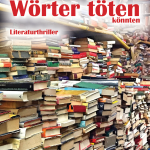
Wenn Wörter töten könnten
Axel Thormählens Literatur-Thriller Wenn Wörter töten könnten ist ein mit einer gehörigen Portion Satire angereicherter, spannender Roman, dessen Handlungen sich hinter den Kulissen des Literatur-Betriebs abspielen. Die verschiedenen Intrigen dehnen sich von Hamburg bis ins schwedische Universitätsstädtchen Lund, um auf der Insel Gotland ihre Auflösung zu finden.
Erschien Anfang Mai 2020 in einer Neuauflage bei JMB Verlag.
Related products

The Brontës and Religion (paperback)
appeared from Cambridge University Press in 1999. The first full-length study of religion in the Brontë fiction, it shows how the Brontës' familiarity with the contemporary debates on doctrinal, ethical, and ecclesiastical issues informs their novels. Divided into four parts, the book examines denominations, doctrines, ethics, and clerics in the work of the Brontës. The analyses of the novels clarify the constant interplay of human and divine love in their development. While demonstrating that the Brontës' fiction is usually in agreement with the basic tenets of Evangelical Anglicanism, The Brontës and Religion emphasises the characteristic spiritual freedom and audacity of the Brontës. Lucid and vigorously written, it opens up new perspectives for Brontë specialists and enthusiasts alike on a fundamental aspect of the novels greatly neglected in recent decades.
Excerpts from reviews: "[a] well-informed [study] based on scrupulous readings and meticulous judgments" (Times Literary Supplement); "[the author's] willingness to read with the grain of the novels' religion makes for absorbing reading" (Victorian Studies); "a refreshingly textual study of the Brontës' fiction" (The Review of English Studies); "a work of extraordinarily comprehensive scholarship" (The Journal of Ecclesiastical History); "the kind of writing which will endure and remain valuable for many years to come" (Theology); "I very much enjoyed this book" (Reviews in Religion & Theology).
The Brontës and Religion, hardback
The Brontës and Religion, paperback


The Water Tower and Other Stories
In these six stories, everyday incidents and situations become extraordinary, lingering on in the reader's memory. For instance, the search for the perfect Christmas tree will never be quite the same again after reading '23 December'.
The pursuit of human happiness in all its different manifestations is at the core of these taut, ironic, and compassionate tales.

The Waste Land a Fragmentary Wholeness
T. S. Eliot is felt by many to have been the poet of the twentieth century, and his famous The Waste Land is the best known poem of that century in English. Many people have found it hard to come to grips with, though, and reading Eliot remains a challenge.
"A hoax", "tripe", a piece of "rhythmical grumbling" (the latter is the poet´s own description) -- is T. S. Eliot´s The Waste Land really worth all the attention it has come in for since its publication in 1922? Thousands of literary critics and scholars have been writing about it -- what inspired such enormous efforts? And will the new millennium gratefully drop it into semi-oblivion as a period piece belonging to the world of yesterday? You´ll know more about The Waste Land, and about Eliot, and about the way you yourself respond to modern poetry after reading Marianne Thormählen´s The Waste Land: A Fragmentary Wholeness. First published in 1978, it has become a standard work on the poem, partly thanks to its generous annotation and bibliography which have helped many students chart their own way through this challenging terrain. The book tells you about the poem´s gestation, Ezra Pound´s midwifery, metre and rhythm in the Waste Land, and the symbolic imagery that is such a powerful dimension in all of Eliot´s work. It also suggests ways of freeing the reader from the obligation to make it all hang together by working out a consistent "plan" or "structure". Let The Waste Land: A Fragmentary Wholeness help you form your own relationship with the greatest modernist poem, unhampered by preconceived notions and unworried by its alleged "difficulty". (Lund Studies in English No. 52, 1978; 248 pp.)

Rethinking Modernism
Around 1979, scholars adopted the term "modernism" as a designation for the radical changes that took place in Anglo-American literature in the early twentieth century. The concept lent prestige to works and authors associated with it, encouraging the development of a vast body of criticism while blocking academic recognition of literature to which it does not readily apply. In Rethinking Modernism, published by Palgrave Macmillan in 2003 and edited by Marianne Thormählen, fifteen scholars of modernism subject the concept to sceptical scrutiny as they revisit their special areas of expertise. The general question they all face is not so much "what was modernism?" -- a familiar question -- as "was/is modernism?" Their results show that although "modernism" remains a useful concept under certain conditions, for them -- as for any reader of this book -- modernism will never be quite the same again.
The book ends with a 20-page bibliography of works on modernism in two parts, compiled by the editor; the Literary Research/Recherche littéraire reviewer called it "comprehensive and invaluable". Other reviewers have praised the book as forming a "both focused and vigorous" volume (The Yearbook of English Studies) and as offering noteworthy "considerations of category breakers and the construction of categories by the reception of literary works" (The Review of English Studies).
https://www.palgrave.com/page/detail/rethinking-modernism-marianne-thormählen/?sf1=barcode&st1=9781403911803
The Brontës and Religion (hardback)
appeared from Cambridge University Press in 1999. The first full-length study of religion in the Brontë fiction, it shows how the Brontës' familiarity with the contemporary debates on doctrinal, ethical, and ecclesiastical issues informs their novels. Divided into four parts, the book examines denominations, doctrines, ethics, and clerics in the work of the Brontës. The analyses of the novels clarify the constant interplay of human and divine love in their development. While demonstrating that the Brontës' fiction is usually in agreement with the basic tenets of Evangelical Anglicanism, The Brontës and Religion emphasises the characteristic spiritual freedom and audacity of the Brontës. Lucid and vigorously written, it opens up new perspectives for Brontë specialists and enthusiasts alike on a fundamental aspect of the novels greatly neglected in recent decades.
Excerpts from reviews: "[a] well-informed [study] based on scrupulous readings and meticulous judgments" (Times Literary Supplement); "[the author's] willingness to read with the grain of the novels' religion makes for absorbing reading" (Victorian Studies); "a refreshingly textual study of the Brontës' fiction" (The Review of English Studies); "a work of extraordinarily comprehensive scholarship" (The Journal of Ecclesiastical History); "the kind of writing which will endure and remain valuable for many years to come" (Theology); "I very much enjoyed this book" (Reviews in Religion & Theology).
The Brontës and Religion, hardback
The Brontës and Religion, paperback


Reviews
There are no reviews yet.