


Hanna
Der Roman Hanna beschäftigt sich mit der Möglichkeit eines in Verruf geratenen jungen Mädchens, ihr eigenes Leben wieder in die Hand zu nehmen und sich in einer Umwelt voller Vorurteile und Doppelmoral als Individuum zu behaupten
Related products

The Ladislaw Case
This sequel to Middlemarch is also in a limited sense a sequel to Dickens’ Bleak House. While there is no need to have read either novel in order to enjoy The Ladislaw Case, acquaintance with George Eliot’s characters and Dickens’ Inspector Bucket enhances the reader’s pleasure in following the twists and turns of the plot and the tribulations of the characters.
Read the blurb text
Click here for a synopsis
Here is a chapter from the book: [Ladislaw Chapter 23.pdf]
"Thormählen writes very well, moves the plot along, and keeps the tension at just the right pitch throughout. She does a particularly good job extrapolating Eliot's characters, convincingly making Ladislaw much less attractive than he is in Eliot's novel and revealing the implications of Rosamond's chilling egotism ... Thormählen ... has created an entertaining re-vision of a major Victorian novel [which] successfully extrapolates elements in [Middlemarch] that both illuminate and criticize [it]." George P. Landow, Editor-in-Chief, The Victorian Web.
'One of the pleasures of reading Imke Thormählen's murder mystery ... is that it works on two levels: even as it unravels the question of who committed the murder, the novel provides a thought-provoking sequel to George Eliot's Middlemarch. /---/ [It contains] ... strong narrative suspense, psychological realism, and a credible Victorian setting ... [I]maginatively and insightfully faithful to George Eliot's vision ... this novel ... reveals some of the hitherto untapped potential that lies latent in ... Eliot's novel and is, at the same time, a very good read indeed.'
Micael M. Clarke, George Eliot -- George Henry Lewes Studies, Nos. 64-65
'The characterization of the main protagonists in the story is generally consistent with that created by George Eliot ... Characters impress us or repel us by what they say. There is no difficulty here in recognizing their voices: the clear sombre voice of the disappointed Dr Lydgate; the excessively polite voice of Rosamond, so quick to criticize her husband and add to his sense of failure in his professional and social life; the irritable and yet self-critical voice of the young politician Ladislaw; the certain tones of Lady Chettam secure in her social position, correcting her sister "Dodo" and yet always caring for her ... If the reader has also devoured Middlemarch, he or she will be eager to meet old friends, to be reminded of some of the darker strands of that story, and ultimately, tense with expectations, excited to discover the murderer. We are kept guessing until very near the end and for most readers the revelation will be a real surprise.'
Ruth and Michael Harris, The George Eliot Review 44 (2013), 88-89

The Brontës and Religion (paperback)
appeared from Cambridge University Press in 1999. The first full-length study of religion in the Brontë fiction, it shows how the Brontës' familiarity with the contemporary debates on doctrinal, ethical, and ecclesiastical issues informs their novels. Divided into four parts, the book examines denominations, doctrines, ethics, and clerics in the work of the Brontës. The analyses of the novels clarify the constant interplay of human and divine love in their development. While demonstrating that the Brontës' fiction is usually in agreement with the basic tenets of Evangelical Anglicanism, The Brontës and Religion emphasises the characteristic spiritual freedom and audacity of the Brontës. Lucid and vigorously written, it opens up new perspectives for Brontë specialists and enthusiasts alike on a fundamental aspect of the novels greatly neglected in recent decades.
Excerpts from reviews: "[a] well-informed [study] based on scrupulous readings and meticulous judgments" (Times Literary Supplement); "[the author's] willingness to read with the grain of the novels' religion makes for absorbing reading" (Victorian Studies); "a refreshingly textual study of the Brontës' fiction" (The Review of English Studies); "a work of extraordinarily comprehensive scholarship" (The Journal of Ecclesiastical History); "the kind of writing which will endure and remain valuable for many years to come" (Theology); "I very much enjoyed this book" (Reviews in Religion & Theology).
The Brontës and Religion, hardback
The Brontës and Religion, paperback

The Brontës and Education (paperback)
All the seven Brontë novels are concerned with education in both senses, that of upbringing as well as that of learning. The Brontë sisters all worked as teachers before they became published novelists. In spite of the prevalence of education in the sisters' lives and fiction, however, this is the first full-length book on the subject. Marianne Thormählen explores how their representations of fictional teachers and schools engage with the intense debates on education in the nineteenth century, drawing on a wealth of documentary evidence about educational theory and practice in the lifetime of the Brontës. This study offers much new information both about the Brontës and their books and about the most urgent issue in early-nineteenth-century British social politics: the education of the people, of all classes and both sexes.
The Brontës and Education, hardback
The Brontës and Education, paperback
Reviews so far
'Compelling and unique ... This thoroughly researched volume looks at ... contemporaneous education controversies. Summing up: highly recommended.' Choice
'... writes with considerable panache and vigor. In this reviewer's experience the book makes a very enjoyable read not only for a scholar public but for a general audience as well'. www.bronteblog.blogspot.com.
Read the whole review at http://bronteblog.blogspot.com/2007/07/bronts-and-education-review.html
'... crisp, objective and lively ... Thormählen triumphs in the light she shines on the educational world in which the family lived ... This book is an exciting helpmate in the struggle to secure a firm understanding of factors that fed the Brontë sisters' imaginative development ...' Brontë Studies
''Thormählen's prose is lucid yet sophisticated, each paragraph redolent with pithy thoughts and new twists on familiar truths ... Thormählen guides us sure-footedly ... [the notes constitute] a veritable textbook on early nineteenth-century education ... [The Brontës and Education is] a deeply satisfying work that enriches our appreciation of the Brontës and their world." Modern Philology
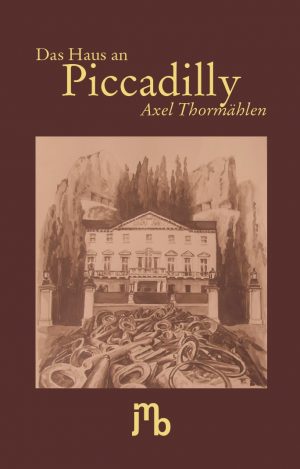
Das Haus an Piccadilly
JMB Verlag, 08 Juni 2012
Ein geheimnisvolles Haus in London erregt seit Jahren die Neugier von Leo Norman. Durch unheimliche Umstände gelangt er an das riesige Schlüsselbund dieses Hauses und stattet ihm einen unvergesslichen Besuch ab ...
Bestellung für Das Haus an Piccadilly an Jens Bolm .
"Hinter Thormählens Sprachwitz steckt ein Philosoph!"
Kunst + Kultur No. I/09

A Happy Man or Der Glückliche
Les Figues Press, Los Angeles 2008
http://www.lesfigues.com
Selected short stories by Axel Thormählen, bilingual edition (English/German)
The tales in this collection could hardly be more diverse where content is concerned, ranging from the Christmas story 23 December to the young love of Dyke Crest Lane No. 1. We also meet the Construction Worker who keeps interrupting our lives with his relentless noise, the ancient church servant Thomas who inhabits the cathedrals where we catch our breath, and the old woman for whom the only uplifting thing is the Water Tower which rises near her house. In the familiar Course of Things, illness, healing process, and death go hand in hand; the Happy Man knows that, too, whereas the Churchgoer is still searching for a monumental meaning in life. We’d better make use of our Visiting Hour even if things keep breaking into little pieces, again and again.
https://www.spdbooks.org/Products/9781934254042/a-happy-man-and-other-stories.aspx
Book Reviews Blog
http://www.dalkeyarchive.com/catalog/show_comment/1594
http://skylightbooks.blogspot.com/2008/07/my-encounter-with-happy-man.html
http://www.bookslut.com/fiction/2008_11_013686.php
http://www.theshortreview.com/reviews/AxelThormahlenAHappyMan.htm
Interview with Axel Thormählen
http://www.theshortreview.com/authors/AxelThormahlen.htm

Wilhelm
Banktjänstemannen Frieder K. är en vanlig familjefar som ställs inför ett ovanligt problem. Vissa tecken tyder på, att hans just avlidne far Wilhelm inte utan vidare låter sig bringas ur världen. Wilhelm dyker upp på det mest oväntade platser, och vissa handlingar finns inte där de borde vara. Frieder offrar dyrbara semesterdagar för att lösa "mysteriet Wilhelm" men blir bara alltmer osäker. Hans välordnade värld hänger helt plötsligt inte ihop längre. Frieder förändras under sitt sökande efter Wilhelm. Han börjar accepteraockså det ovissa och skrämmande i tillvaron, och gränsen mellan hans och faderns identiteter blir alltmer diffus för honom. Ur hans synvinkel blir tankegångar och handlingarsom för utomstående ter sig absurda, för att inte säga groteska, enbart logiska och nödvändiga.
Romanen om Frieder och hans far utspelar sig inom en generations nutid och förflutna, en generation vars första år sammanföll med Tredje Rikets Tyskland.
Beställ via förlagets hemsida, www.ellerstroms.se


Reviews
There are no reviews yet.