


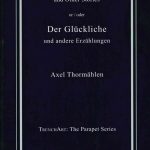

The Water Tower and Other Stories
40.00 kr
In these six stories, everyday incidents and situations become extraordinary, lingering on in the reader’s memory. For instance, the search for the perfect Christmas tree will never be quite the same again after reading ’23 December’.
The pursuit of human happiness in all its different manifestations is at the core of these taut, ironic, and compassionate tales.
Related products

The Ladislaw Case
This sequel to Middlemarch is also in a limited sense a sequel to Dickens’ Bleak House. While there is no need to have read either novel in order to enjoy The Ladislaw Case, acquaintance with George Eliot’s characters and Dickens’ Inspector Bucket enhances the reader’s pleasure in following the twists and turns of the plot and the tribulations of the characters.
Read the blurb text
Click here for a synopsis
Here is a chapter from the book: [Ladislaw Chapter 23.pdf]
"Thormählen writes very well, moves the plot along, and keeps the tension at just the right pitch throughout. She does a particularly good job extrapolating Eliot's characters, convincingly making Ladislaw much less attractive than he is in Eliot's novel and revealing the implications of Rosamond's chilling egotism ... Thormählen ... has created an entertaining re-vision of a major Victorian novel [which] successfully extrapolates elements in [Middlemarch] that both illuminate and criticize [it]." George P. Landow, Editor-in-Chief, The Victorian Web.
'One of the pleasures of reading Imke Thormählen's murder mystery ... is that it works on two levels: even as it unravels the question of who committed the murder, the novel provides a thought-provoking sequel to George Eliot's Middlemarch. /---/ [It contains] ... strong narrative suspense, psychological realism, and a credible Victorian setting ... [I]maginatively and insightfully faithful to George Eliot's vision ... this novel ... reveals some of the hitherto untapped potential that lies latent in ... Eliot's novel and is, at the same time, a very good read indeed.'
Micael M. Clarke, George Eliot -- George Henry Lewes Studies, Nos. 64-65
'The characterization of the main protagonists in the story is generally consistent with that created by George Eliot ... Characters impress us or repel us by what they say. There is no difficulty here in recognizing their voices: the clear sombre voice of the disappointed Dr Lydgate; the excessively polite voice of Rosamond, so quick to criticize her husband and add to his sense of failure in his professional and social life; the irritable and yet self-critical voice of the young politician Ladislaw; the certain tones of Lady Chettam secure in her social position, correcting her sister "Dodo" and yet always caring for her ... If the reader has also devoured Middlemarch, he or she will be eager to meet old friends, to be reminded of some of the darker strands of that story, and ultimately, tense with expectations, excited to discover the murderer. We are kept guessing until very near the end and for most readers the revelation will be a real surprise.'
Ruth and Michael Harris, The George Eliot Review 44 (2013), 88-89

The Brontës and Religion (paperback)
appeared from Cambridge University Press in 1999. The first full-length study of religion in the Brontë fiction, it shows how the Brontës' familiarity with the contemporary debates on doctrinal, ethical, and ecclesiastical issues informs their novels. Divided into four parts, the book examines denominations, doctrines, ethics, and clerics in the work of the Brontës. The analyses of the novels clarify the constant interplay of human and divine love in their development. While demonstrating that the Brontës' fiction is usually in agreement with the basic tenets of Evangelical Anglicanism, The Brontës and Religion emphasises the characteristic spiritual freedom and audacity of the Brontës. Lucid and vigorously written, it opens up new perspectives for Brontë specialists and enthusiasts alike on a fundamental aspect of the novels greatly neglected in recent decades.
Excerpts from reviews: "[a] well-informed [study] based on scrupulous readings and meticulous judgments" (Times Literary Supplement); "[the author's] willingness to read with the grain of the novels' religion makes for absorbing reading" (Victorian Studies); "a refreshingly textual study of the Brontës' fiction" (The Review of English Studies); "a work of extraordinarily comprehensive scholarship" (The Journal of Ecclesiastical History); "the kind of writing which will endure and remain valuable for many years to come" (Theology); "I very much enjoyed this book" (Reviews in Religion & Theology).
The Brontës and Religion, hardback
The Brontës and Religion, paperback


Der letzte Wikinger
JMB Verlag Hannover
ISBN 9783944342542
Illustrationen von Peter Kirchhof
Endlich gibt es eine Auswahl der besten Erzählungen von Axel Thormählen auf Deutsch:
Über die in den U.S.A. herausgegebene Auswahl A Happy Man and other Stories (Les Figues Press) schrieb Claude Rawson, Literaturprofessor an der Yale University: „Ein entzückendes, ungewöhnliches, hochindividuelles Buch mit einer milden Weisheit, manchmal beunruhigend oder belustigend oder beides zugleich, aber immer unverwechselbar.“

Rethinking Modernism
Around 1979, scholars adopted the term "modernism" as a designation for the radical changes that took place in Anglo-American literature in the early twentieth century. The concept lent prestige to works and authors associated with it, encouraging the development of a vast body of criticism while blocking academic recognition of literature to which it does not readily apply. In Rethinking Modernism, published by Palgrave Macmillan in 2003 and edited by Marianne Thormählen, fifteen scholars of modernism subject the concept to sceptical scrutiny as they revisit their special areas of expertise. The general question they all face is not so much "what was modernism?" -- a familiar question -- as "was/is modernism?" Their results show that although "modernism" remains a useful concept under certain conditions, for them -- as for any reader of this book -- modernism will never be quite the same again.
The book ends with a 20-page bibliography of works on modernism in two parts, compiled by the editor; the Literary Research/Recherche littéraire reviewer called it "comprehensive and invaluable". Other reviewers have praised the book as forming a "both focused and vigorous" volume (The Yearbook of English Studies) and as offering noteworthy "considerations of category breakers and the construction of categories by the reception of literary works" (The Review of English Studies).
https://www.palgrave.com/page/detail/rethinking-modernism-marianne-thormählen/?sf1=barcode&st1=9781403911803

Verksamhetsberättelser
Ytterligare 13 konturskarpa berättelser. De nya berättelserna visar på en breddning av Thormählens litterära register. Förutom inslaget av svidande samhällssatir, som känns igen från de tidigare böckerna, ingår tre sinsemellan mycket olika kärlekshistorier i denna samling. Vidare finns reflexioner kring skeendena inom och utom den tysk-svenska verklighetens råmärken och en avslutande, klassisk julberättelse som suddar ut gränser av mer än ett slag.
"Berättelserna präglas av Thormählens finurliga infallsvinklar och ironiska distans och försätter läsaren omväxlande i en road och eftertänksamt allvarlig stämning."
Monika Ivarsson, Skånska Dagbladet
"Inte minst den skenbart paradoxala föreningen av satir och solidaritet, av lekfull distans och djup humanitet, gör läsningen till ett oavbrutet nöje."
Magnus Eriksson, Svenska Dagbladet
"Hans verksamhetsberättelser vill värna det skapande momentet i människors liv."
Göran Lundstedt, Sydsvenska Dagbladet
Beställ via förlagets hemsida, www.ellerstroms.se


Reviews
There are no reviews yet.